

A guy in a lifted black F-250 texts you: “How much for ceramic?” You remember the detailer across town advertises “ceramic from $499,” so you fire back “$900 out the door” before you lose him. He books. Then you see the paint. Swirls everywhere, sap on the hood, a bed liner that drinks product. The prep eats a full day, you burn through two bottles of coating, and after nine hours you clear maybe forty bucks. You did not price a ceramic coating. You guessed, and the truck won.
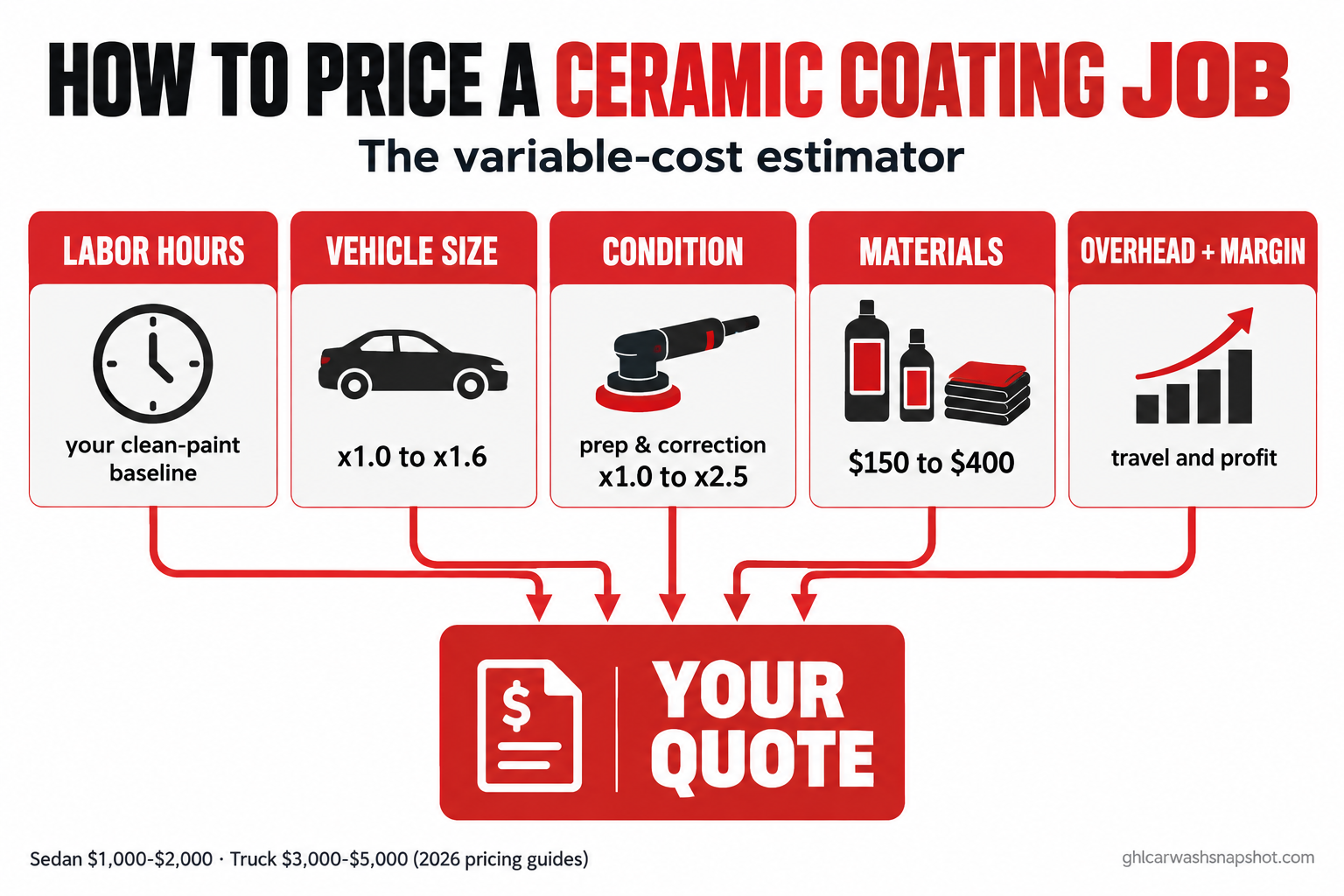
Here is the fix: price a ceramic coating from what it costs you to deliver, not from what the shop down the road charges. Build every quote from five numbers: your loaded labor hours, the vehicle size, a condition multiplier for prep and correction, your material cost, and your overhead plus target margin. Do that and your cheapest job still clears a real profit, your hardest job stops bleeding you, and you can defend the price with a straight face. This is the variable-cost estimator, and it takes about five minutes per quote once it is built.
Table of contents
- Why competitor pricing breaks you
- What a ceramic coating costs to deliver
- The variable-cost estimator
- Three real quotes, built the same way
- Where detailers blow up a quote
- Steal these: messages that hold your price
- Protect the price in writing
- Objections, answered
- FAQ
Why “match the shop down the road” is the fastest way to go broke
Competitor-based pricing feels safe. It is the most dangerous way to quote, because it anchors your number to a business whose costs you cannot see. The $499 ceramic ad is a hook: the shop is either skipping paint correction and calling a drive-by spray “ceramic,” or eating the labor to win a review. You cannot copy a price without copying the cost structure behind it, and you have no idea what that is.
You do not need to be the cheapest. The US car wash and auto detailing industry is worth about $18.7 billion across roughly 16,879 businesses, per IBISWorld. Ceramic is the high-ticket end of that market, and those buyers shop on trust and finish, not price alone.
Now the math on getting it wrong. Quote a flat $900 for every ceramic job and a clean sedan leaves you $500 of profit for six hours, while a neglected truck needing two-stage correction leaves you $40 for ten hours. Flat pricing trains you to dread the exact high-ticket work that should pay best, and drags your effective hourly rate below what you would earn washing cars.
Two ways to quote a ceramic job
Pricing by feel: glance at the car, recall a competitor's flyer, blurt a number. The clean jobs overpay, the hard jobs lose money, and your worst days are your busiest.
Pricing from cost: five inputs, five minutes, a number you can defend. Every job clears a real margin, the hard trucks finally pay for the hours they take.
What a ceramic coating actually costs you to deliver
Before you set a price, you need the true cost of one job. It breaks into four buckets, and only one moves much from car to car.
Materials. The coating, plus panel wipe, prep pads, applicators, microfibers, and tape. For one vehicle this runs roughly $150 to $400 depending on coating tier and how many panels and layers you run. The key fact: materials barely change between an easy car and a hard one.
Labor, the one that swings. A simple coating on clean paint might be two to three hours. A full job with two-stage paint correction can run eight to ten hours. Chemical Guys and others put two-stage correction alone at roughly $600 to $1,200 of billable work. Your cheapest and priciest ceramic jobs differ almost entirely in prep hours.
Overhead. Rent or rig payment, insurance, polishers, water, power, software, phone. A per-hour cost you carry on every job, and most solo detailers forget it.
Your labor cost floor. Federal wage data for people who clean vehicles (BLS code 53-7061) puts the national median near $35,830 a year, about $17.24 an hour (Bureau of Labor Statistics). That is the floor for unskilled hands, not what a skilled installer should value their hour at, but it proves the labor line is real money even when the hands are yours.
Here is where the money goes on a mid-range job, a worked example built from the cost inputs above (not a survey). Treat the shares as a model you adjust.
Worked example: a $1,500 ceramic job split into cost and profit. Inputs modeled from BLS wage data and reported coating-material ranges; your figures will differ.
The point jumps out. Materials are the smallest controllable slice; labor is more than half the job. If your estimator measures anything, it has to measure hours.
The variable-cost estimator: any quote in five numbers
Set this up once in a spreadsheet or your booking software, and every quote becomes a five-minute job, not a gut call.
Quote = (Base labor hours x Vehicle size tier x Condition multiplier x Loaded hourly rate) + Material cost + Overhead + Travel + Target margin
1. Base labor hours. Your clean-paint baseline. For a straightforward coating with a light single-stage polish, call it 5 to 6 hours on a sedan.
2. Vehicle size tier. More panels, more product, more time.
| Vehicle size | Multiplier |
|---|---|
| Coupe / small sedan | 1.0 |
| Midsize sedan / small SUV | 1.15 |
| Full-size SUV / crossover | 1.35 |
| Full-size truck / van | 1.6 |
3. Condition multiplier. The single most important input, and the one detailers leave out. It prices the prep and correction the paint actually needs.
| Paint condition | What it needs | Multiplier |
|---|---|---|
| Near-new, light swirls | Wash, decon, single-stage polish | 1.0 |
| Normal daily driver | Wash, decon, one-stage correction | 1.4 |
| Heavy swirls, defects | Two-stage correction | 1.9 |
| Neglected, deep scratches | Multi-stage, wet sanding | 2.5+ |
4. Loaded hourly rate. Not minimum wage. It has to cover your skill, your overhead per hour, and a profit on your time. Most detailers charge $50 to $100 an hour for skilled work, per detailing-pricing guidance from Jobber. For a ceramic specialist, $75 to $95 is common.
5. Materials, overhead, and margin. Add your material cost ($150 to $400), a flat overhead-per-job figure if it is not already in the hourly rate, mobile travel, and your target margin.
Now sanity-check against the market. Reported 2026 guides put pro ceramic coatings at $1,000 to $2,000 for a sedan and $3,000 to $5,000 for a truck, and package systems like Ceramic Pro tier by warranty length before correction. Your estimator should land inside those bands.
What customers pay for professional ceramic coating by vehicle type, 2026 (midpoint of reported ranges from aggregated pricing guides). A market sanity check, not your quote.
Three real quotes, built the same way
One formula, three very different jobs. Watch the same math protect you across all three.
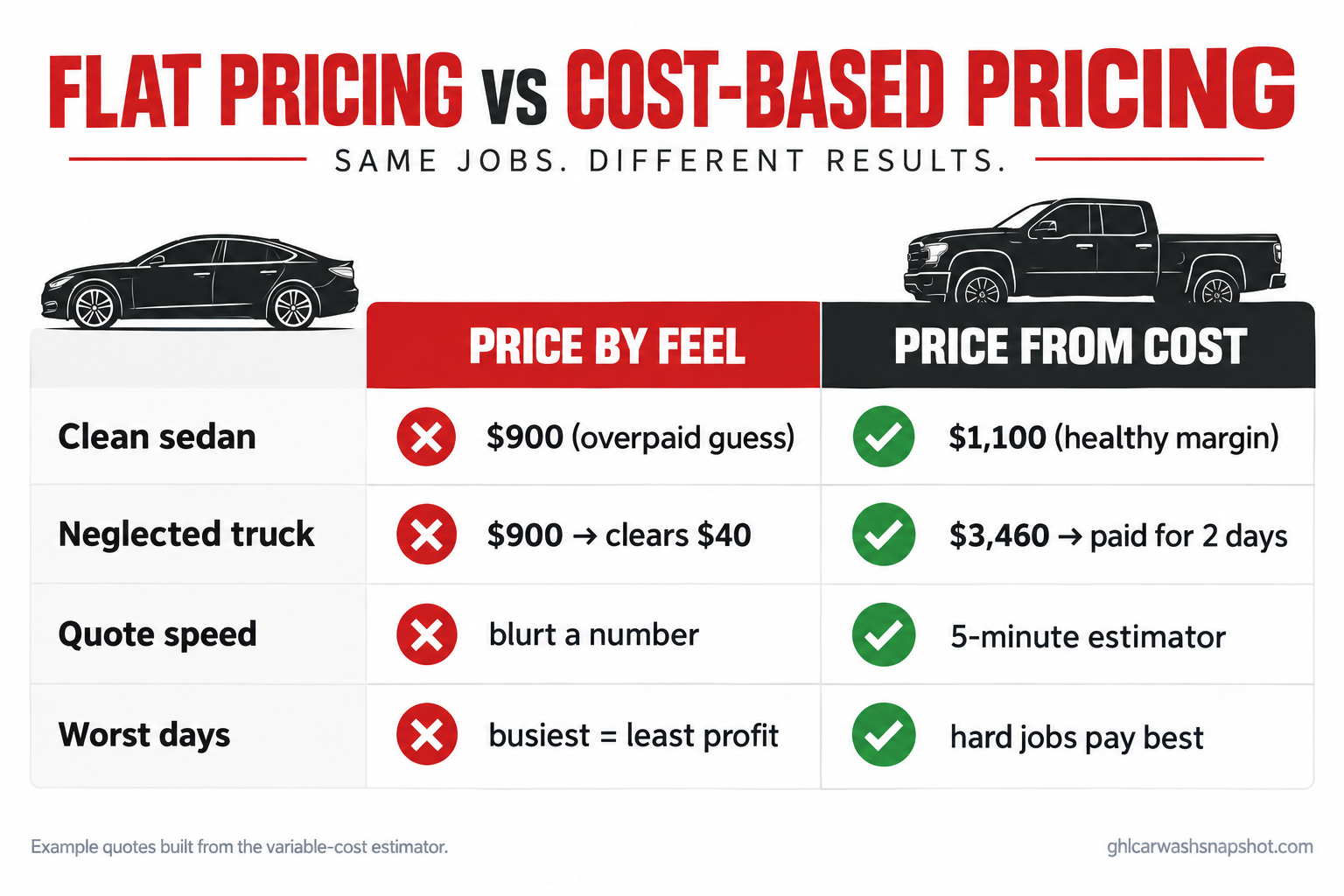
Scenario 1: solo mobile detailer, clean two-year-old Camry, five-year coating. Base hours 5, size 1.15, condition 1.0, rate $80. Labor: 5 x 1.15 x 1.0 x $80 = $460. Materials $220, travel and overhead $120, margin $300. Quote: about $1,100. Right in the sedan market, healthy profit, six hours.
Scenario 2: small shop, daily-driver Highlander with real swirls. Base hours 5, size 1.35, condition 1.9, rate $85. Labor: 5 x 1.35 x 1.9 x $85 = $1,090. Materials $300, overhead $150, margin $400. Quote: about $1,940. The condition multiplier does the heavy lifting; a flat-rate shop that quoted $900 just lost a thousand dollars of labor.
Scenario 3: high-end studio, neglected lifted F-250. Base hours 6, size 1.6, condition 2.5, rate $95. Labor: 6 x 1.6 x 2.5 x $95 = $2,280. Materials $380, overhead $200, margin $600. Quote: about $3,460. A two-day job, and the price finally pays for two days. This is the exact truck that cleared forty bucks on flat pricing. Built from cost, it is one of your best jobs of the month.
Same five inputs every time. The customer never sees the formula, only a confident number from a detailer who knows the work.
Where detailers blow up a ceramic quote
The formula only works if you stop making these five mistakes. Each is a real way the price breaks.
Underpricing prep because the coating is the “product.” The coating is the cheap part. Detailers price the bottle and treat the correction as a throw-in. That is backwards. Fix: quote correction as its own line with its own hours. Industry pricing treats two-stage correction as a $600 to $1,200 service of its own, per Chemical Guys and Mobile Tech RX.
Quoting from a text instead of the car. You cannot see swirls, sap, or a repaint over SMS. Fix: the photo rule above, or quote a range and confirm after inspection, in writing.
Forgetting travel on mobile jobs. A 40-minute drive each way is unbilled time plus fuel, every job. Fix: a flat travel fee by zone, baked into the estimator.
No deposit, so a no-show costs a booked day. Ceramic jobs are long, and a last-minute cancel on a two-day slot is a hole you cannot refill. Same problem we broke down in why mobile detailing customers cancel at the last minute. Fix: a non-refundable deposit at booking.
Scope creep with no change order. “While you’re at it, can you do the wheels and glass?” That is more hours and product for free unless you say otherwise. Fix: a scope-change message (below) that re-prices add-ons before you touch them.
Steal these: the messages that hold your price
Copy these, swap in your details, and save them as canned replies. They turn a price into a booked, deposit-backed job without renegotiating every time.
Quote-request auto-reply (sent the second they text “how much”):
Thanks for reaching out about ceramic coating! Price depends mostly on your paint’s condition, so I quote accurately, not blind. Can you send 3 photos: the full driver’s side in daylight, a close-up of the worst panel, and the odometer? I’ll send a firm number within the hour. Or book an in-person look here: [link]
Firm quote (after you see the car or photos):
Here’s your ceramic quote for the [vehicle]: $[price]. That covers [wash + decon + X-stage correction + Y-year coating on all painted panels]. It’s a [one-day / two-day] job. A $[deposit] deposit holds your slot and comes off the total. Lock in [date]?
Deposit request (keeps the slot real):
To book you in, I take a $[amount] deposit that applies to your balance and holds your [date] slot, so I’m not turning away work for a day that doesn’t happen. Secure link: [link]. Balance due at completion.
Scope-change message (kills free add-ons):
Happy to add [wheels off / glass coating / trim]! That’s an extra $[amount] and about [time] more. Want it added to today’s job? Reply yes and I’ll update your total.
“Why we cost more than the $499 place”:
Most of a real ceramic job isn’t the coating, it’s the paint correction underneath, which is [hours] of machine polishing. A sub-$500 ceramic skips that, so the coating seals your swirls in instead of removing them. My price corrects the paint first, then protects it, so it looks right for years. Happy to show a before/after on a test panel.
These cover the full path from first text to money in the bank, and the faster they go out, the more jobs you hold. If you lose quotes because you cannot reply with your hands in a foam cannon, that is the gap we covered in losing mobile detailing leads after hours, and what an AI caller and text-back layer is built to close.
Protect the price in writing
A good quote is only half the job. The other half is making sure the agreed number is the number you get paid.
Put the scope in writing. The firm quote message above is your contract in miniature: correction stages, panels, coating, years. When a truck turns out worse than the photos showed, a written scope lets you re-quote instead of swallowing the hours. “Final price confirmed on inspection” is a fair clause.
Take a deposit, and set refund terms clearly. A deposit filters tire-kickers from real buyers. State the terms plainly at booking: what it is, that it applies to the balance, and whether it is refundable and by when. Being upfront keeps you clear of state consumer-protection rules on prepayments; the FTC’s business guidance is a plain-English start. For a real refund policy, get a one-time look from a lawyer in your state.
Price containment into your overhead. Rinsing correction slurry and wash water into a storm drain can carry real penalties under the Clean Water Act and local rules, a cost most detailers never quote, as we covered in mobile detailing wastewater rules.
Objections, answered
“Isn’t this overkill? I’ve priced by eye for years.” Pricing by eye works on easy jobs and quietly murders you on the hard, highest-ticket ones. The estimator takes five minutes, and the first neglected truck it prices correctly pays for itself ten times over. You are adding a floor under your worst days, not bureaucracy.
“My customers will balk at a higher number.” Some will, and those were never your customers. The market pays well above the bargain price, $1,000 to $2,000 for a sedan. A confident, itemized quote that explains the correction underneath closes better than a vague low number, because it signals you know the work.
“I’m mobile and solo. Do I really need to charge overhead and travel?” Especially then. Your rig, insurance, fuel, and drive time are real costs. Skip them and you subsidize every job out of pocket. Operators who track this run far healthier margins, the whole reason to use software built for mobile detailing instead of a notebook.
FAQ
How much should I charge for a ceramic coating in 2026?
Build the number from cost, not competitors. Professional coatings commonly run $1,000 to $2,000 for a sedan and $3,000 to $5,000 for a truck per 2026 pricing guides. Use the variable-cost estimator to land a profitable number inside that band.
Why does ceramic coating pricing vary so much between cars?
Because the coating is the cheap, fixed part and the paint correction is the expensive, variable part. Materials run about $150 to $400 whether the paint is clean or trashed, but the hours of wash, decon, and correction swing a quote by hundreds. That is why a condition multiplier is the most important input.
How much do the materials for a ceramic coating actually cost?
Roughly $150 to $400 per vehicle for the coating plus consumables like panel wipe, applicators, pads, tape, and microfibers. A multi-year 9H system with primers reaches the top of that range. Either way, materials are the smallest controllable slice.
Should I charge for paint correction separately?
Yes. Quote correction as its own line with its own hours so the customer sees prep and coating are two different jobs. Industry sources price two-stage correction at $600 to $1,200 on its own. Bundling it invisibly is how detailers give away a day of labor.
How do I quote ceramic coating without seeing the car?
Require three photos first: the full driver's side in daylight, a close-up of the worst panel, and the odometer. Quote a range and confirm the final price on inspection, in writing. Never fire off a firm verbal number from a text, because you cannot see swirls or a repaint over SMS.
Do I need a deposit for ceramic coating jobs?
Strongly recommended. Ceramic jobs often run one to two full days, so a last-minute cancellation leaves a hole you cannot refill. A non-refundable deposit at booking holds the slot, filters tire-kickers, and applies to the balance.
The takeaway is simple. Stop pricing ceramic coatings against a flyer and start pricing them against your real cost. Five inputs, five minutes, a number you can defend, and a deposit-backed booking. Do that on every quote and the neglected black truck stops being the job you dread and becomes one of the best-paying days on your calendar.