

It is the first of the month and your billing report just landed. Three hundred and eleven members charged, nineteen declines, forty-one cancellations since last month. You add two signups and feel okay about it. You should not. “Forty-one cancellations” means nothing without the two numbers underneath it: how fast your base leaks, and what each member was worth on the way out. Most owners track signups like a scoreboard and never calculate the two figures that decide whether the club grows or bleeds.
Here is the fix: run your unlimited wash club on exactly two numbers. Your monthly churn rate (the percentage of members who cancel each month) and your member lifetime value (LTV, the total margin one member throws off before they leave). Churn tells you how fast the bucket drains. LTV tells you what each drop was worth, and how much you can spend to refill it. Calculate both from five inputs you already have, compare them to the 2026 benchmarks below, then pull the three levers that move them. That is the whole game.
Table of contents
- What losing a member actually costs you
- The two numbers that run your wash club
- How to calculate your monthly churn rate
- How to calculate member lifetime value
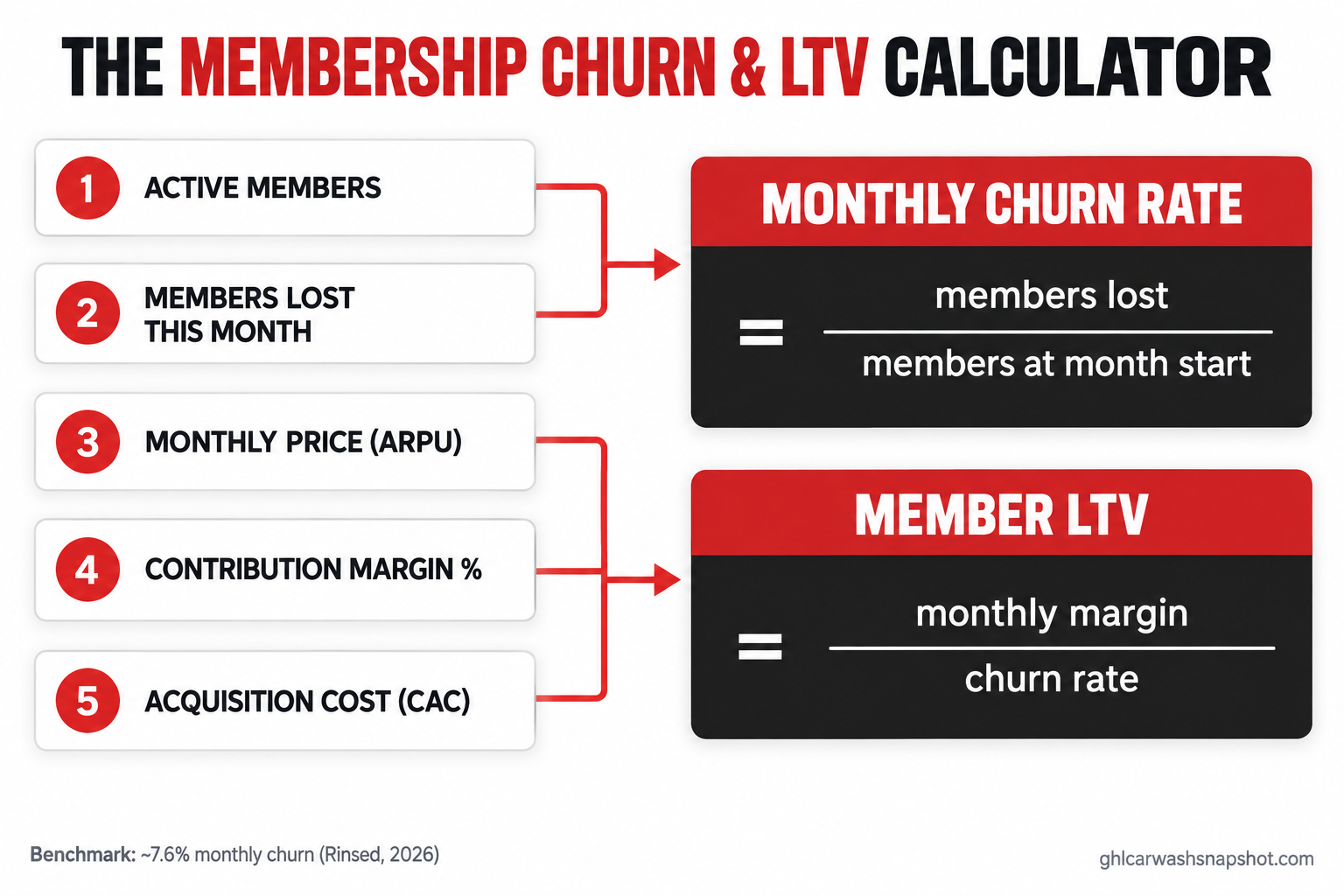
- The calculator: your five inputs, two answers
- Three wash clubs, one formula
- Where operators get churn and LTV wrong
- Steal these: retention messages that protect LTV
- The cancellation rule everyone gets wrong
- Objections, answered
- FAQ
What losing a member actually costs you
A subscription member generates about $440 over 36 months against roughly $64 for the average retail customer, about 315% more revenue, per the Cinch Retail-to-Member Report. Cancel a member and you lost the rest of a $440 relationship, not one wash.
Now the leak rate. Car wash membership churn in 2026 runs near 7.6% a month: 4.7% voluntary and 2.9% involuntary (failed and expired cards), per Rinsed’s Q3 2025 report. A club of 1,000 losing 7.6% sheds 76 a month. Fail to replace all 76 and then some, and your base shrinks while the signup board says “busy.”
The upside is just as real. Research from Bain and Company’s Fred Reichheld, popularized by Harvard Business Review, found lifting retention by five points can raise profits 25% to 95%. And members are stickier than owners fear: about 91% say they plan to renew, per the ICA Car Wash Pulse report, and 54% of former subscribers still come back to the same location after cancelling, per ICA. The audience wants to stay, so your job is to measure the leak and plug it.
The two numbers that run your wash club
Forget dashboards with forty tiles. Two figures tell you almost everything.
Monthly churn rate. The share of members who cancel or lapse in a month. It is your best early warning: it moves before revenue does, so a club can post record signups and still be dying if churn climbs faster.
Member lifetime value (LTV). The total contribution margin one average member produces before leaving. LTV connects retention to money and caps your acquisition spend.
The two are welded together by one piece of math most owners never see: average member lifespan (months) = 1 / monthly churn rate. A 5% churn means the average member stays 20 months; a 10% churn halves that to 10. Lifespan, and therefore LTV, is the inverse of churn. Shave two points off churn and you do not improve LTV by two points, you stretch the whole relationship.
How to calculate your monthly churn rate
The formula is grade-school simple. The discipline is counting it honestly.
Monthly churn rate = members lost during the month / active members at the start of the month.
Begin March with 1,000 members, lose 74 by month end, and March churn is 74 / 1,000 = 7.4%. Watch the trend, not the single reading.
The part almost everyone skips: split churn into voluntary and involuntary. They have completely different fixes.
- Voluntary churn is a member actively cancelling, about 4.7% a month (Rinsed). You fight it with onboarding and a save flow.
- Involuntary churn is a card that expired or declined and never recovered, about 2.9% a month. These members did not decide to leave; a card reissued and they stopped paying. You fight it with dunning, not discounts.
Average monthly car wash membership churn, 2026, split by cause. Source: Rinsed Q3 2025 Car Wash Industry Report. Over a third of all churn is involuntary, the cheapest kind to fix.
More than a third of your leak is failed cards, which means a third of your churn is a billing problem, not a loyalty problem. We go deep on that in silent card churn, and it is the fastest churn win most operators have sitting untouched.
How to calculate member lifetime value
LTV is really just “what is a member worth,” and for a wash it is three inputs.
LTV = (monthly price x gross margin %) x average member lifespan
Folding in the lifespan formula, that is just monthly contribution margin per member / monthly churn rate. Say your plan is $30 a month, and after the variable cost of washing that member you keep about $20 of contribution margin. At 5% churn, lifespan is 20 months, so LTV = $20 x 20 = $400. At 10% churn, LTV falls to $200. Same price, same margin, half the value, because the bucket drains twice as fast.
Modeled member LTV at different monthly churn rates, holding contribution margin at $20 per member per month. The curve is steepest where most clubs sit, 7 to 10%. Plug in your own margin; the shape does not change.
Now LTV earns its keep. The 3:1 rule of thumb, popularized by David Skok’s SaaS metrics work, says a healthy business earns at least three dollars of lifetime value for every dollar of customer acquisition cost (CAC). Flip it: your LTV caps what you can pay to sign a member. At a $400 LTV you can spend about $130 and still clear 3:1; at $200 LTV that ceiling drops to $65. High churn does not just shrink LTV, it caps your whole marketing budget and hands the operator down the road room you no longer have.
The calculator: your five inputs, two answers
Five numbers you already have, two answers that run the club. Build it once in a spreadsheet, update it monthly.
- Active members at the start of the month. Straight from billing.
- Members lost this month. Cancellations plus failed cards that never recovered. Count both.
- Monthly price (ARPU). Average revenue per member. If you run tiers, use the blended average, not the top plan.
- Gross contribution margin %. The share of that price you keep after the variable cost of one more wash. Express tunnels land high here.
- Customer acquisition cost (CAC). Total acquisition spend (ads, kiosk incentives, promos) divided by new members signed.
Now the two answers:
| Step | Formula | Example |
|---|---|---|
| Monthly churn rate | Input 2 / Input 1 | 74 / 1,000 = 7.4% |
| Average lifespan (months) | 1 / churn rate | 1 / 0.074 = 13.5 |
| Monthly margin per member | Input 3 x Input 4 | $30 x 67% = $20 |
| Member LTV | Monthly margin x lifespan | $20 x 13.5 = $270 |
| LTV:CAC ratio | LTV / Input 5 | $270 / $55 = 4.9:1 |
That bottom line is your reality check: above 3:1 you have room to grow, below it you are buying members for more than they are worth. For the full member funnel, see our unlimited wash club launch playbook.
Three wash clubs, one formula
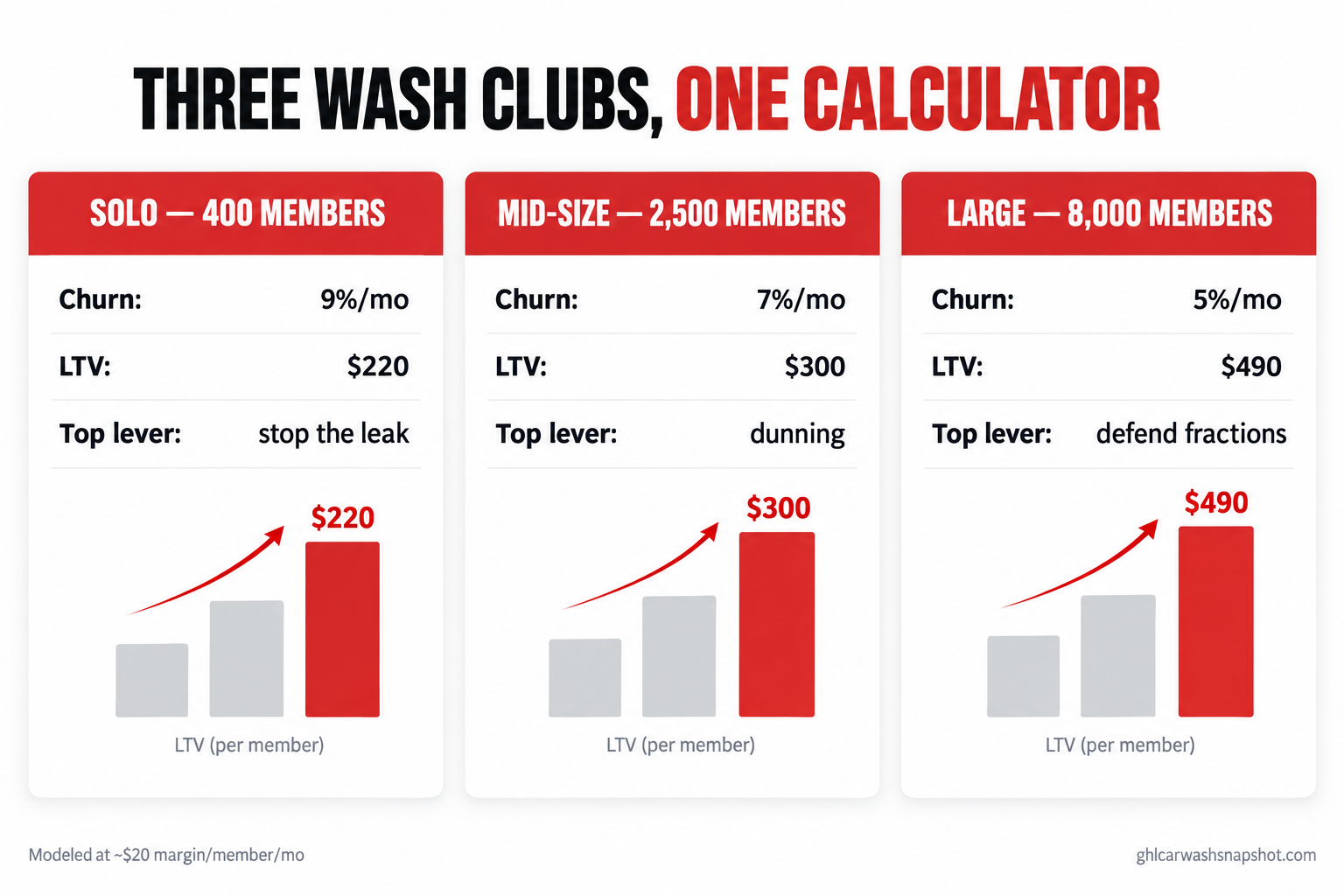
One calculator, three operations, a different problem in each.
Club A: solo single-site express, 400 members. Price $30, margin 67% ($20 a month), churn a rough 9% because signup is a clipboard and nobody fights failed cards. Lifespan 11 months, LTV $220. At 9% they lose 36 members a month and must sign 36 just to tread water, at a $40 CAC, so about $1,440 a month buys zero growth. Cut churn to 6% (LTV $333) and the same spend grows the base. Their problem is not acquisition, it is a 9% leak.
Club B: mid-size, three locations, 2,500 members. Price $32, margin 66% ($21 a month), churn 7% with some automation. Lifespan 14.3 months, LTV $300. Recover half their card churn and churn drops to about 5.75%, LTV rises to $365, a 22% lift from billing hygiene alone. Their best lever is the cheapest one: dunning.
Club C: large operator, five locations, 8,000 members. Price $35, margin 70% ($24.50 a month), churn 5%, in line with Mister Car Wash’s Q3 2025 earnings call. Lifespan 20 months, LTV $490. At this scale a single half-point is 40 members, about $1,400 of MRR a month. That $490 LTV is a weapon: it lets them spend about $160 per member at 3:1 and outbid every smaller operator in the metro, where fractions of a percent are five figures a year.
Same five inputs every time. The number quietly killing each club is different, and you cannot see which without running the calculator.
Where operators get churn and LTV wrong
The calculator only works if the inputs are honest. Five mistakes quietly corrupt them.
Counting only cancellations as churn. Ignore cards that silently declined and you undercount churn by about a third. Fix: count a failed card that does not recover inside your dunning window as churn, clicked or not.
Treating renewal intent as proof you are fine. “91% say they plan to renew” is intent, and an industry figure, not yours. Fix: measure actual retained members month over month from your own billing data.
Measuring LTV without margin. Multiplying $30 by lifespan gives you revenue, not value. Water, chemicals, and card fees are real. Fix: use contribution margin, or an inflated LTV will tell you to overspend.
Blending seasons into one number. A spring reading on a club that spikes in summer misleads you both ways. Fix: track a trailing 3-month and a year-over-year churn, so the saw-blade demand we cover in weather-triggered promotions does not masquerade as a trend.
Averaging across cohorts. New members churn far harder than seasoned ones, so one blended number hides a first-30-day cliff. Fix: track churn by cohort. DRB’s data shows new members who wash three or more times in month one are 76% more likely to recharge; those washing 1.7 times or fewer are 75% less likely to reach month two.
Steal these: retention messages that protect LTV
Four levers move the two numbers, in order of return on effort: recover failed cards (the cheapest 2.9%), nail the first 30 days, run a real cancellation save flow, and win back the lapsed (54% still wash at your site). Here is the actual copy behind all four. Swap in your details, load them as automated messages, and the faster each fires, the more LTV you keep.
Onboarding nudge, day 3 (starts the wash habit):
Hey [name], welcome to the [Club] unlimited club! Members who wash in their first week get way more out of the plan. Your tag is active now, so swing by any lane this week, no kiosk stop needed.
Failed-card recovery, text 1 (sent the hour a card declines):
Hi [name], the card on your [Club] membership didn’t go through this month, so your washes are paused. It takes 30 seconds to update it and you’re back in the lanes: [secure link].
Failed-card recovery, text 2 (48 hours later if still unpaid):
[name], still can’t run your membership card. We don’t want to cancel a plan you’re using, so here’s the quick fix: [secure link]. If you meant to cancel, reply CANCEL and I’ll take care of it.
Cancellation save flow (fires when a member clicks cancel):
Before you go, [name]: would a pause work better than a cancel? I can hold your plan for one month at no charge so you keep your rate when you come back. Reply PAUSE. Or if we got something wrong, tell me and I’ll make it right.
Win-back, lapsed 45 days:
Hi [name], we miss your [vehicle] in the lanes. Come back to the unlimited club this month and your first month is [offer]. Same fast lanes, same tag, reactivate here: [link].
Each maps to a line in the calculator: onboarding and the save flow cut voluntary churn, the card texts cut involuntary churn, win-back recaptures lapsed LTV. Running them on autopilot is what the CRM workflow automations in the system are built for.
The cancellation rule everyone gets wrong
One warning before you build a save flow, because the rule most operators think governs it does not. In July 2025 the FTC’s “click-to-cancel” negative-option rule was vacated by the Eighth Circuit Court of Appeals, so it is not in force. Plenty of owners are still designing around a rule that no longer exists.
What actually governs membership cancellation is a patchwork of state automatic-renewal laws (the California ARL is strictest, and more than a dozen states have their own) plus Section 5 of the FTC Act. The upshot: your save flow can make an offer, but it cannot trap a member who clearly wants out, and in several states cancellation must be about as easy as signup. We break it down state by state in car wash membership auto-renewal laws. Build the flow to persuade, never to obstruct. This is not legal advice, so confirm your state’s rules with a local attorney.
Objections, answered
“I already know my churn is ‘about 7%.’ Do I need to calculate it?” A rough feel and a measured, split, cohort-level churn are different tools. “About 7%” cannot tell you that a third of it is recoverable failed cards, or that your first-30-day cohort churns at 15% while veterans sit at 3%. The calculator turns a vague worry into a specific line item: knowing you have a leak versus knowing which pipe.
“LTV is a tech-startup metric. I run a car wash.” LTV is just the honest price of a member, and you bet on it every time you spend to acquire one. The question is whether you bet with a number or a hunch. Operators who know their LTV know their acquisition ceiling, which is why the ones using software built for membership can outspend a clipboard operation and still profit.
“Won’t chasing churn cost more than it saves?” The two highest-return levers, card recovery and onboarding, are automated texts that cost pennies and target members who already want to stay. You are not buying anything new, you are stopping paid-for members from leaking out a hole a message can close. At a $300 LTV, saving ten members a month is $3,000 of recovered value for the price of a few texts.
FAQ
What is a good monthly churn rate for a car wash membership in 2026?
Average total monthly churn runs around 7.6%, split into roughly 4.7% voluntary and 2.9% failed cards, per Rinsed's Q3 2025 report. Best-run operators hold near 5%, like Mister Car Wash. Above 10% means you are on an acquisition treadmill.
How do I calculate member lifetime value for my wash club?
LTV = monthly contribution margin per member multiplied by average lifespan, where lifespan is 1 divided by your monthly churn rate. So $20 of margin a month at 5% churn gives a 20-month lifespan and a $400 LTV. Use contribution margin, not price, or you will overspend on acquisition.
What is the difference between voluntary and involuntary churn?
Voluntary churn is a member actively cancelling, fought with onboarding and a save flow. Involuntary churn is a card that expired or declined and never recovered, fought with dunning. They run about 4.7% and 2.9% a month, so roughly a third of churn is a billing problem, not a loyalty one.
What is a healthy LTV to CAC ratio for a car wash membership?
The rule of thumb is at least 3:1, meaning three dollars of lifetime value for every dollar of acquisition cost. Below 3:1 you are buying members for close to what they are worth, which signup volume cannot fix.
Does the FTC click-to-cancel rule apply to my wash membership?
No. The FTC 'click-to-cancel' negative-option rule was vacated by the Eighth Circuit in July 2025 and is not in force. Cancellation is governed instead by state automatic-renewal laws such as the California ARL and by Section 5 of the FTC Act. Confirm your state's rules with a local attorney.
Back to that billing report. Forty-one cancellations and nineteen declines becomes a diagnosis the moment you run the two numbers: a 6% churn you can push toward 5%, a third of it in failed cards you can recover this week, and a $300 LTV that tells you how hard to market. The club that measures the leak plugs it; the club that only counts signups keeps bailing water and calling it growth. Run the calculator this month and watch that number start moving your way.